“How do you manage to write a book?”
I get this question quite a bit, from mixed-experience writing servers on Discord to my own mother in a phone call. And, despite my best efforts to sabotage myself, I have written six novels – two of which are self-published, the other four in various stages of editing – in a little over ten years of serious writing. And while I’ve improved my process over the last decade, the core of it remains the same.
For this blog post, I’ll use the example of the still-unnamed pirate fantasy book that I have outlined to illustrate how I go from an idea (a phrase, a couple of words, or even just a feeling!) to a full-fledged outline. I haven’t written this book yet, but this will serve as the core to the story for when I do choose to draft it.
I am an outliner, not a panster. That means that start my story with a skeleton of what the story will look like and
The Inception of an Idea
Everybody loves pirates.
I wasn’t a kid who was super into pirates – not like my 5-year-old’s friend who is obsessed with them to the point where her parents had a Captain Jack Sparrow impersonator show up at her birthday party! – but Pirates of the Caribbean holds a special place in my heart. The original 3 movies are great films, blending the real-world Golden Age of Piracy in the Caribbean with the mystical world of the Black Pearl, zombies, voodoo, and Davy Jones. Full disclosure, I like the 4th one (more info on that later!) and thought the 5th one was just ok. Still, they left me wanting more, and Hollywood didn’t seem to want to provide it.

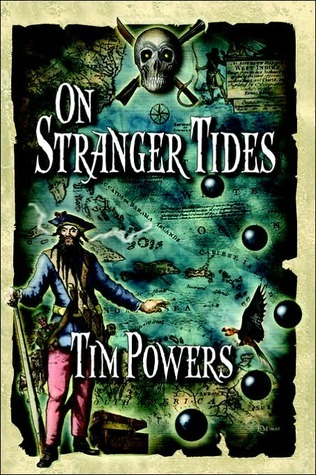
I did, however, find it in both books – Tim Powers On Stranger Tides (which Pirates 4 was based on!).
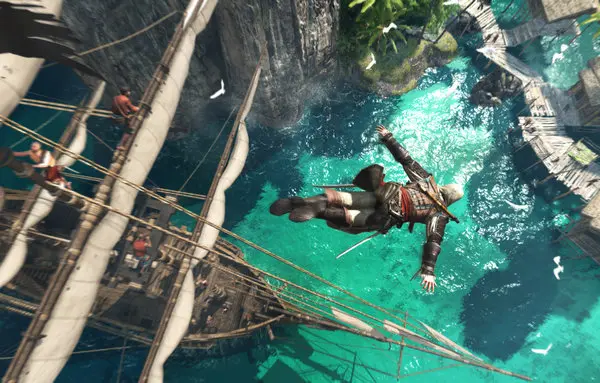
And video games, namely Assassin’s Creed IV: Black Flag and the Risen series.
I started thinking way back in maybe 2018 or 2019 about a pirate fantasy novel, and looking at my writing notebook (which I’ll go more into detail in a different post about how I keep notes), there’s two words – “pirate fantasy” – before “novel,” meaning I always had this planned as a novel-length work.
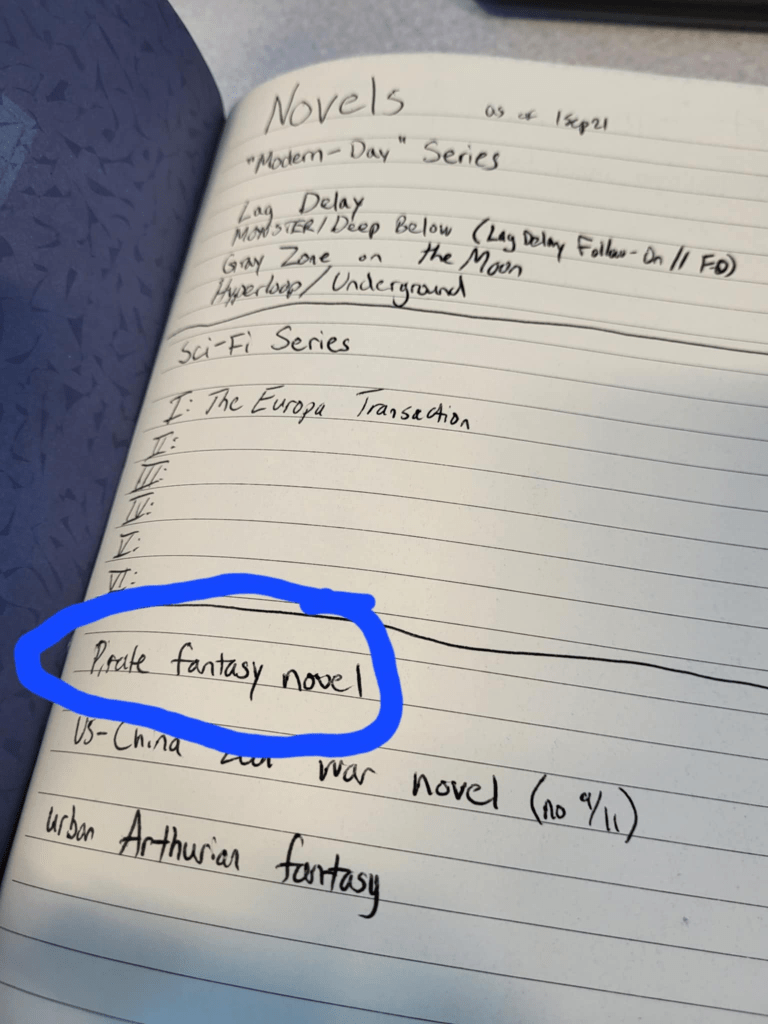
That’s it – that’s how it started. Two words, jotted down in early 2021 (when I started that notebook).
From an Idea to 3 Acts
Those two words weren’t much to start with.
I had to take those – and a general overall feel of a pre-industrial Caribbean away from the prying eyes of colonial powers – and make that into an outline that can eventually be developed into a story.
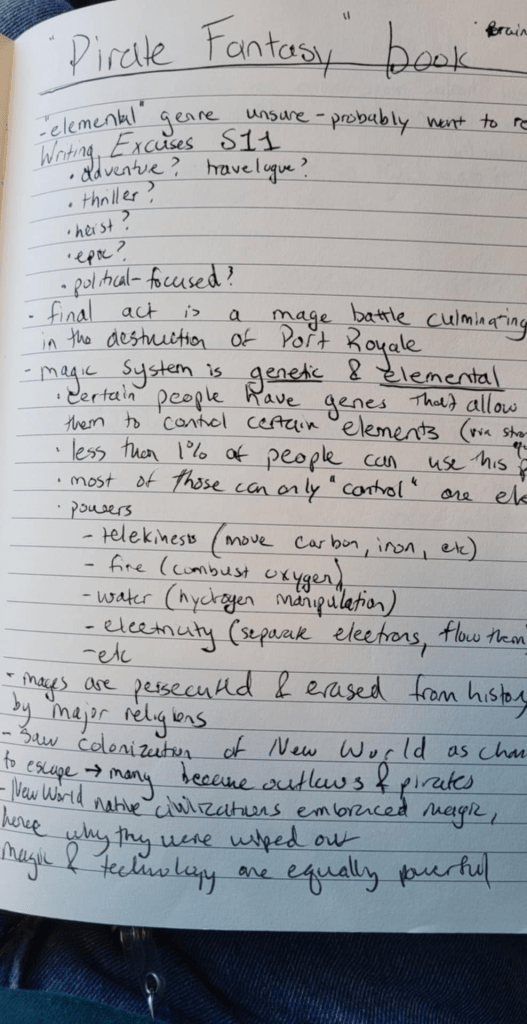
I like to steal plot structures from other books – who doesn’t? But, for this still-unnamed book, I wanted something at least somewhat unique. I listened to Writing Excuses (one of my favorite writing podcasts) Season 11, but none of the elemental genres that they discussed worked for what I wanted to do. I wrote a lot of things down in the notebook, much of which has ended up in the worldbuilding for the novel, but the plot and structure still escaped me.
So I did some reading, mostly of 18th and 19th century literature, while I was working on The Martian Incident and Lag Delay. Some of the feedback that I got on those books is that I was week with character motivation – the plot drove the characters, not the other way around.
And, after I read Alexandre Dumas’ The Count of Monte Cristo, I had it. A revenge plot.
Characters and plot threads swirled in my mind, and I put them down on paper in my notebook – which, if you couldn’t tell, I use primarily for brainstorming and to get ideas down quickly so they can’t escape my thrice-concussed brain. I am a student of Robert McKee. My writing friend Brian Crenshaw introduced me to his book Story, and the “archplot” contained in there. It’s a fairly basic three-act structure but distilled down into its core parts, and I use variants of it for almost all of my books and stories.
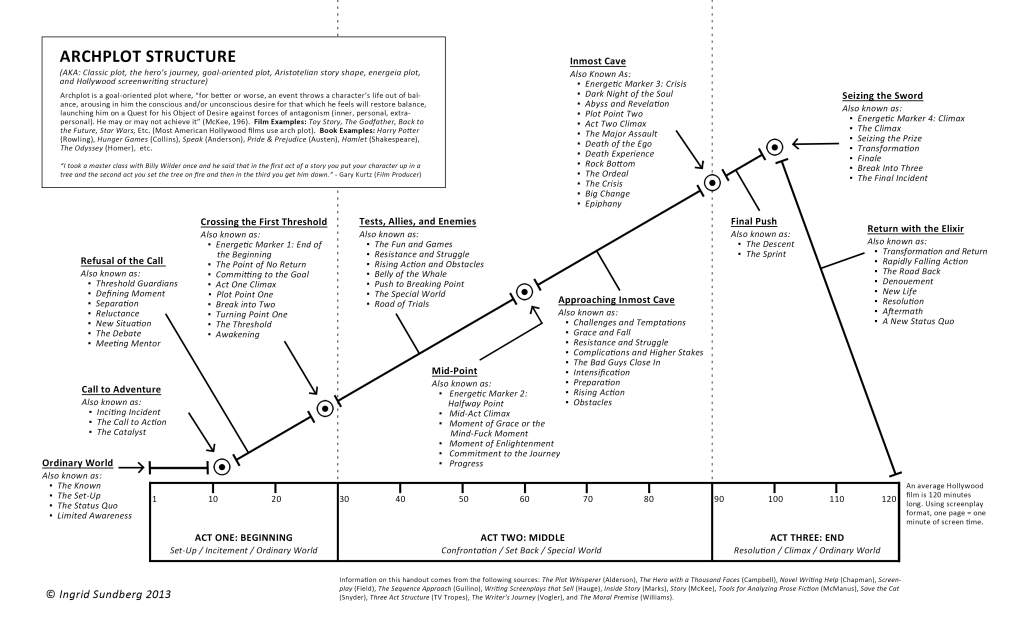
I took those ideas and quickly wrote a paragraph for each act, then later typed it into a Google Doc. This came quickly, maybe an hour spent on this at the most, but it’s a start. Most of my ideas come stream-of-conscious like this – when they come, they flow, and I need to get them down on paper ASAP.

Then, the Outline
I now have 3 acts of content, with a couple of sentence describing at a high level what happens in each one.
But, that’s not enough of an outline. I actually got through The Martian Incident with just that, but I had to come up with a lot of the meat of the story during drafting. Much of that had to be fixed in the editing phase.
I do best with every chapter mapped out, but with room to “pants” and improvise within the outlined structure of the story. This means I need to give each chapter a description. Usually this is one sentence, but for big ones with more things happening I might have two or three. I don’t put much dialog into this outline either. That’s something that I come up with on the fly – and a part of writing that I really enjoy!
I usually spend a couple hours on this, and here’s a page of the result.
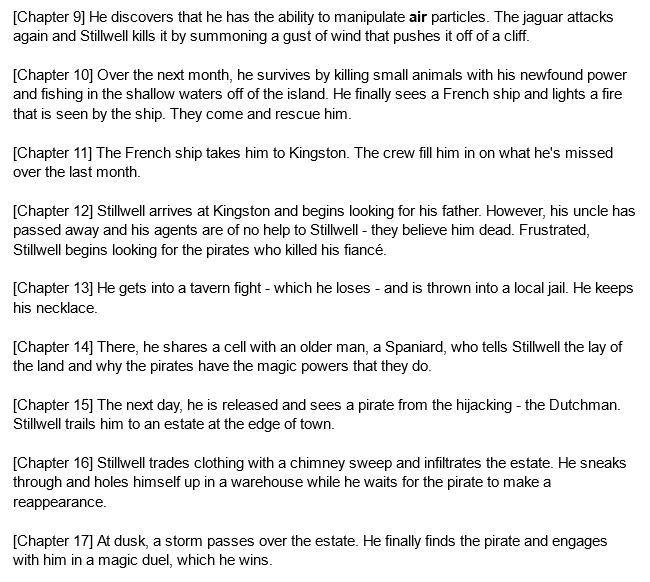
See how I added a prologue, and added plenty of characters and depth that weren’t in the original 3 paragraphs. I start with the main character and his fiance leaving England for the New World, only to get her killed by pirates as soon as they reach the Caribbean. I know “fridging” is a passe trope, but that’s only part of the protagonist’s motivation – his fortune that he is set to inherit is gone as well, stolen by the pirates. He then will hunt down three of the four pirate captains in sequence, slowly increasing his magical power, before engaging in a magic duel outside of Port Royale that causes the earthquake that destroyed the town in the historic record. No scenes, no chapters, just the overall high-level plan of each act. However, it does let me get the overall “shape” of the plot down and then I can fix the details later.
The Advanced Outline
This isn’t like a lot of other books that I write. Most of them have one primary thread, which the main plot of the story as well as the primary character arc follow, and everything else is secondary. My pirate-fantasy novel is different; the main character drives the plot for multiple reasons, and changes drastically in his drive for revenge across the Caribbean. For that reason, I decided to make sure that all of the sixty (!) chapters of the still-unnamed novel advance one of the plot or character arcs.
For this, I needed something more expansive than just a bullet-point outline. I spoke with some of my writing friends, and one of them suggested a spreadsheet.
That didn’t make sense when I first heard it. A spreadsheet in Excel or Google Sheets is a 2-dimension database, usually used for finance or engineering – not writing. But, the more I thought about it, the more it sounds like a good idea. It would allow me to show how different arcs develop over the course of the book and to ensure that the different subplots get the correct amount of time on the page.
Here’s what it looks like:
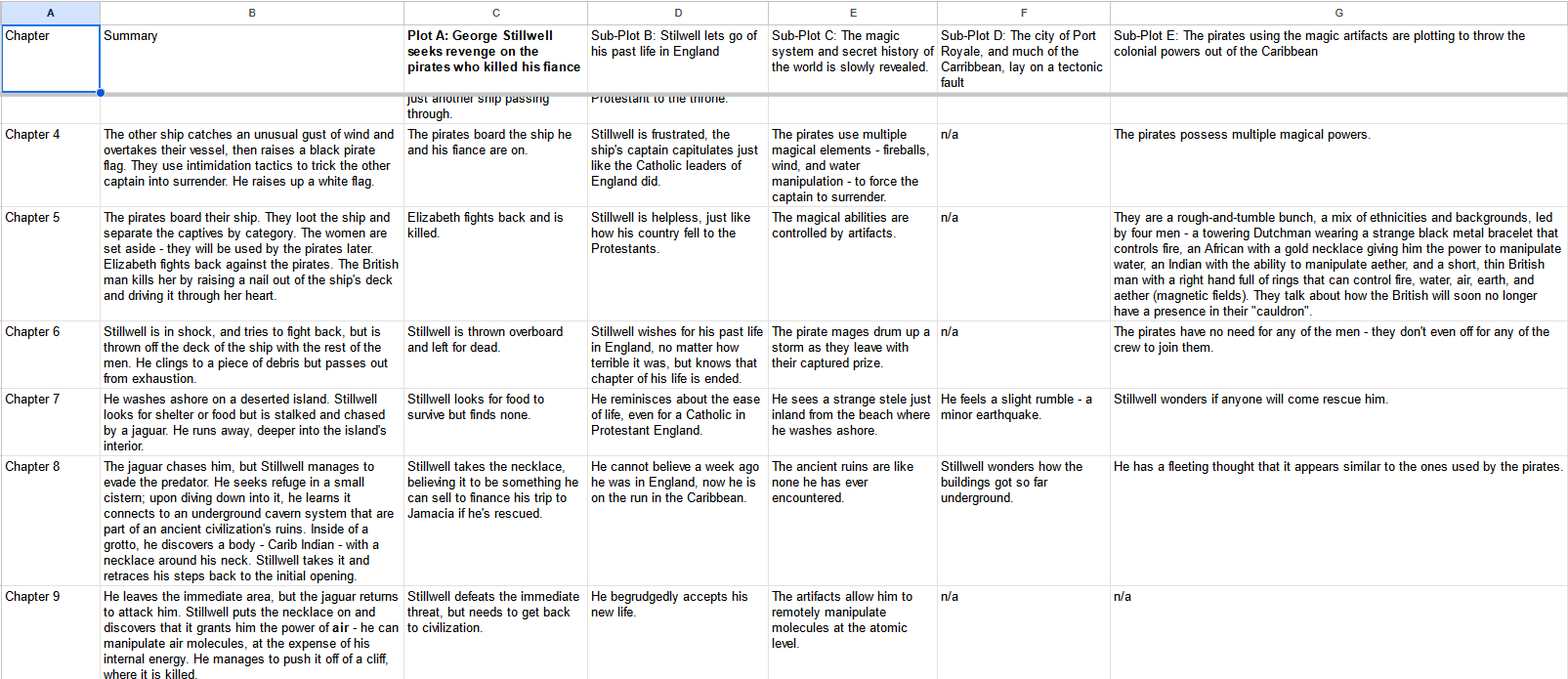
I still have it broken up into chapters, but I go more in depth with what the main character – who has a name now, George Stillwell – does and says in each one. It’s still not perfect, but it gives me enough information to start drafting the book.
What comes next?
In theory, I have enough information to start writing the still-unnamed novel. I have a full outline, character names and arcs, and a complete plot that’ll probably end up as a 120,000 to 140,000 primary world fantasy novel.
But, if you’ve been following my blog posts, you know that there’s 1 real villain in my writing story – time. I work 50-60 hours a week, I have a house, wife, four daughters, and a dog to take care of, and writing sometimes isn’t my #1 priority (as much as I want it to be!). In addition, there’s other demands on me as well. I have two published novels and am working on a sequel to the second one (Lag Delay) plus working on my “one golden idea” – The Europan Deception – to self-publish or potentially go to an indie press. I’m also trying to write some more short stories as well!
The moral of the story is that despite the fact that this is one of my oldest, best ideas for a story, I’m not getting to it anytime soon. I’m currently letting it marinate in the back of my head while I work on some other books and when the time is right, I’ll draft it. I’ll have a future post on my drafting process, but focusing on Lag Delay (which is published) rather than on a book that hasn’t seen the light of day yet.
Thanks, and I hope it was potentially helpful to someone…or at least enlightening into the mess that is my writing brain!

 Ryan M. Patrick
Leave a comment