Following on from my posts How I Outline and How I Draft, here’s How I Edit!
First Things First
I don’t edit while I write – at all. If I know there’s an issue, I take a note in my notebook or make a comment in Word. This helps me keep going to get to a finished draft without getting bogged down fixing things.
Once I’m done with a draft, I’m done. I let it sit for two to four weeks and then I start going through it. At that point, I’m a fairly neutral observer – which I’m not in the middle of drafting. I can clearly see if there’s huge issues with the draft and it needs to be trunked, or if I can move on to the next stage – developmental editing.
Large Developmental Edits
This is one that I don’t really rely on my beta readers for – and I trust them on a lot of things, just not this. I read 50-100 books a year and I generally understand how a story is supposed to flow. Maybe it’s hubris, maybe it’s wrong, maybe I’m an idiot, but unless an alpha/beta reader understands what I’m trying to do, I don’t take their advice when it comes to changing huge parts of the book.
It’s something I do myself.
I’ve done this on all of my books, save for The Martian Incident. Adding or removing set pieces across chapters is a huge undertaking and I don’t need feedback on things that may or may not end up in the final product. Lag Delay originally had a multi-chapter arc at a game developer, The Europan Deception had a long set piece in Warsaw, and so on and so on. Usually these large changes occur before they go out to my alpha readers.
Alpha Readers
These are my most trusted critique partners who have usually been reading my mostly-raw stuff for years. I usually prep them with some high-level questions and let them tear me apart. There’s no focus on line-level stuff – just big picture questions. “Do you like this character?” “Does the plot skip around too much?” “Do you understand what’s going on?”
Usually, in this phase, I only use 4-5 alpha readers.
Small Developmental Edits
After this step, I make some smaller developmental edits. Usually it’s in terms of character motivation – a huge bugaboo for me – and pacing. Then, I go through using Word’s Review feature and do a basic copyedit to make it a cleaner document – get rid of all of the misspellings and whatnot.
Beta Readers
Then, the beta readers. I wrote about that more here and my quest to find more high quality ones. I always prep them with questions to answer at the end to make sure I have the plot down. The type of feedback I’m looking for is both high-level and low-level – am I repeating too many words? Does the pacing drag at times? Are there any plot holes or anything unexplained?
I’ll repeat this step as needed once I make changes, and occasionally bring in alpha readers to read an updated draft.
Copyedits/Proofreading
After that, it’s copyedits, which I combine with proofreading. I go line-by-line and make sure that I use the right word, the right homonym or spelling, and all of my formatting is spot-on. Then, I load it into Kindle Create and generate a .kpf file, and finally once I’ve got the preorder set up I order an author proof.
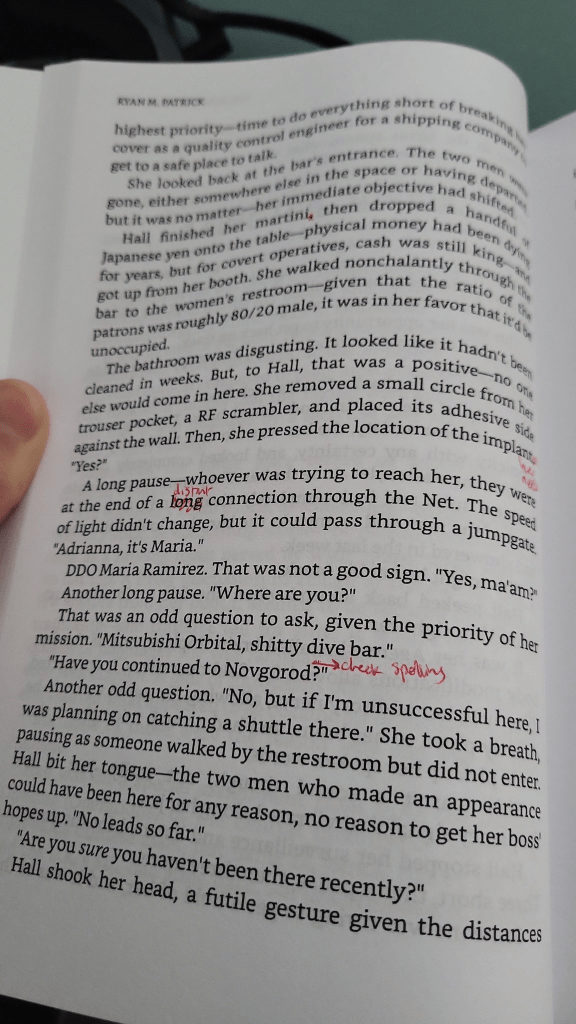
Gotta love that red pen!
After that, I make my edits in Kindle Create and then make sure that the final version is good to go a few days before launch.
 Ryan M. Patrick
Leave a comment