I am working on some other posts in this vein but they’re longer and require more research than this one. But I am absolutely fascinating by the confluence of AI and creative writing and I feel like I need to start getting my thoughts on it out. Part 1 of this series will be on AI-generated writing vs human writing.
I am not anti-AI by any stretch. It’s here, it’s the future, and I am firmly in the camp of “if you won’t use AI, you won’t be replaced by AI, you’ll be replaced by someone using AI.” I use Claude Code and our internal LLM models daily in my day job and they’ve been a huge boon to my productivity – I can do twice as much work as I was able to do before I started with it. So when I make this statement, it isn’t because I hate AI or am a Luddite in this matter.
AI-generated creative writing sucks.
There’s no other way to put it. It’s weak, it’s not fun to read, and most of all it’s soulless. You can clock it almost instantly. Don’t get me wrong – LLMs have a ton of use cases with respect to writing (and I’ll do some future posts on those). But while the text that it generates appears to be “good” on first glance, the more you look at it, the worse it gets.
I’m going to compare the first page or so of my book The Europan Deception (hard sci-fi thriller) to a few different models (Grok, Claude, Gemini – I’m not a ChatGPT fan even on its best day) and show you what I mean.
First Things First
I pulled the first chapter from The Europan Deception and fed it into Claude and Grok to back out a prompt, then made a couple of small modifications to it based on my knowledge of LLMs and writing. This is what I’ll use in each of the models to generate the chapter. Note that I’m only comparing the first page, but I did have it generate the whole first chapter – you can get the flavor from just page one.
Here’s my prompt:
Write a suspenseful third-person opening chapter following Mark Clancy, a weary DIA covert operative and former F-77A Rapier pilot, as he tracks an arms dealer named Paul Esteves through the gritty, domed Martian colony of Zhongnanhai. The narrative should blend atmospheric world-building—from bustling fish markets to high-end international districts—with the use of high-tech espionage tools like rotor-blade drones and augmented reality contact lenses. Focus on a sequence where Clancy surreptitiously observes a tense meeting between criminal factions regarding a “Net” cyber weapon, only for the mission to be upended when an unexpected assassination of a local official occurs. Maintain a noir-inspired tone that balances Clancy’s professional calculations with brief, somber reflections on his past life and a lost loved one. Keep it between 2000 and 2500 words.
Grok
I use Grok a lot in my personal life – it’s fast and accurate and I pay my $8 for Twitter Premium to get access to its best models. But it’s not great for creative writing:
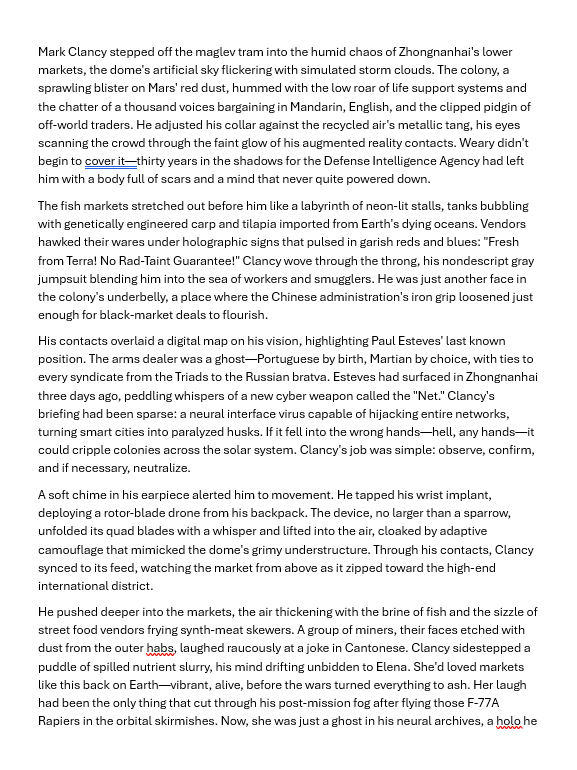
This is so generic that I want to rip my eyes out. Each paragraph has layers and layers of description that overwhelm the reader. There’s a lot of AI “tells” – the word “tang,” the gratuitous em-dashes, “nondescript gray jumpsuit” – but they’re not as bad as the writing itself. “Elena” is an AI name, one of the most common for female characters. And worst of all, it blows almost everything that I gave it in the first page, causing it to have to hallucinate details (like “Elena”) the deeper in it gets.
Not great!
Gemini
I’ve heard through the grapevine that Gemini’s latest model (3) is the best for creative writing. But I wasn’t impressed by it either.
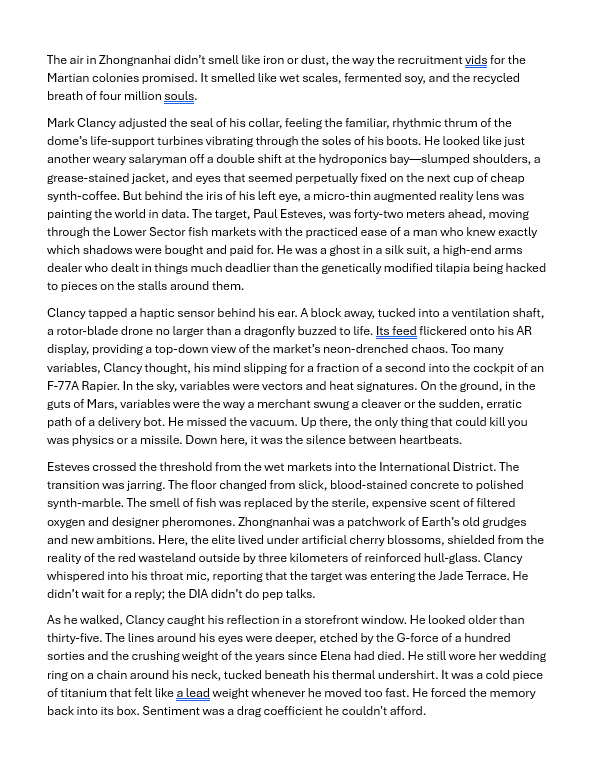
This is slightly better in a lot of ways. But it overwhelms the reader with sensory details, including a lot of AI tells (“smelled like wet scales”). And the similes and analogies (“He was a ghost in a silk suit”, “Zhongnanhai was a patchwork of Earth’s old grudges and new ambitions”) are just off, you can tell that a human didn’t write them. And “DIA didn’t do pep talks” is so cliche. It’s an improvement over Grok but not markedly so.
Claude
I had high hopes for Claude. I use Claude Code every day at work and Sonnet 4.6 and Opus 4.6 have really helped my workflow. But…
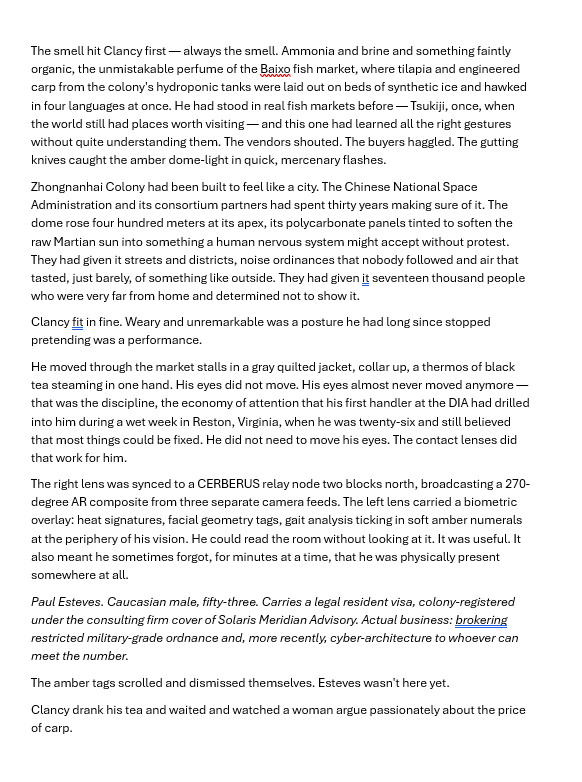
This is arguably the worst of the three. The sensory overload is obviously AI, the info-dumps are the LLM trying to show its research, and the hedging throughout is just incredibly weak writing. The Reston, Virginia aside is factually incorrect – DIA doesn’t do any training here (I work in my company’s Reston office)! Of all of the models, this is the one I would be the least likely to continue reading.
Human Text
And now, written the old-fashioned way…
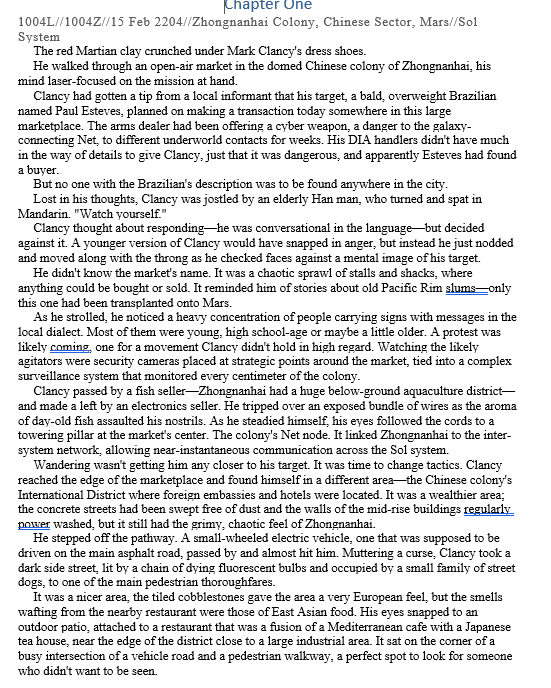
So, I’m obviously biased – I wrote this many moons ago. It’s not my best writing, but I think it’s clear as day that it’s got a soul to it that the AI-generated chapters lack. There’s little asides (old Pacific Rim slums) that give the text depth and the sensory details – taste, smell, touch, sight, hearing – aren’t overwhelmed; they’re instead spread out.
It’s also got a distinct voice. I am a unique data point in a sea of writers – I am first and foremost an aerospace engineer and an author second. I write clear prose that only occasionally uses literary devices like similes and I have a well-defined writing style. And it’s consistent through the entire text. The three AI-generated chapters lack that. They are an average of all of the writing material that they have been trained in. Yes, you can tell it “Write in the style of Tom Clancy” or “Write in the style of Tim Powers” but even then it’s an average of those authors’ works (or whatever it thinks their styles are).
And this is with a clear, descriptive prompt that I backed out of my own human-generated chapter! If you told it something more generic “Write me a first chapter to a sci-fi espionage thriller novel set on a partially-colonized Mars” you’d get something even worse!
I love AI for certain things, some aspects of writing included (and I’ll touch on them more in future posts). But having it generate text is going to result in a weak, soulless output that someone who’s been exposed to even a little of it will instantly be able to detect as AI. If AI was better, it’d be an entirely different conversation – maybe you could use it to fill in the blanks (write a difficult chapter) or something along those lines. And maybe it’ll get there. But right now, AI-generated creative writing sucks.
 Ryan M. Patrick
Leave a comment