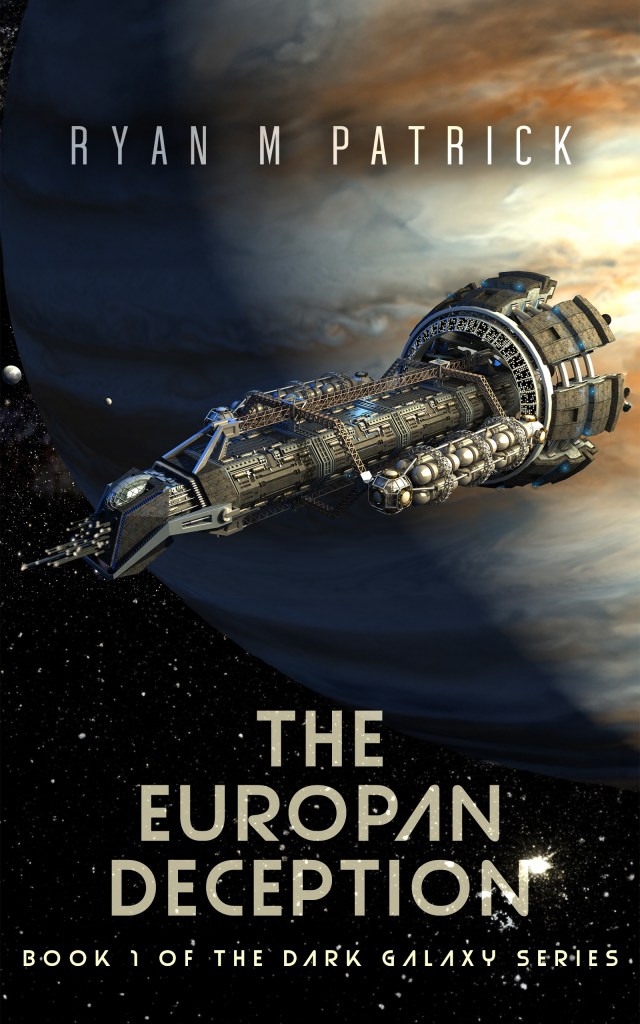
This was the original prologue for The Europan Deception. It was cut sometime between the last two or three drafts before the final version – given my experiences with The Martian Incident and Lag Delay, I know now that I have to catch the reader almost immediately when they click the “Read Sample” button on Amazon. While I absolutely love the following scene, it doesn’t really do that for what I’m advertising as a fast-paced sci-fi thriller novel. Still, it’s one of the key drivers of the entire series, and if you know your (pseudo) history, you’ll know what event takes place here!
0605L //0705Z//Date Unknown//Location Unknown//Sol System
Typhon Marpoli sat on a long wooden pew inside of the constabulary with his head in his hands.
His wife hadn’t wanted him to go to work today.
She had encountered a foul omen in her dreams the previous night. Something awful was going to happen to their city, a downfall would befall it due to their excesses and pride.
Marpoli didn’t believe any of it. But, her vision made him concerned as well. He shook his head to straighten out his troubled mind.
A fellow gendarme, one of his best troops, walked up to him with Marpoli’s lightly armored headgear. “Sir,” he said gently.
Marpoli took it but didn’t look up. He was still deep in thought. With a shrug, the other man walked off. He took a deep breath, held it in his chest, then let it out before standing up.
Raising his arms, he began to don his armor, protecting himself for the coming mission, the oddest one of his long and storied career in internal security.
He began with the black leather cuirass, fastening it tightly to his chest. Next, he put on the dark grey pauldrons, made up of an unknown metal alloy, balancing them atop his shoulders. The right one had a red diagonal mark across it, signifying him as a lieutenant in the security force. He followed with jet-black greaves, encasing his shins in steel. His silver vambraces then came next, encircling his forearms with a shiny protective coat.
At last, he secured the gorget around his neck, completing the full suit of armor. He stood tall, proud, and ready to face whatever may come.
Pushing his wife’s warning to the farthest, deepest corner of his mind, Marpoli strode, helmet in hand, down a well-lit corridor of the central district’s constabulary to the ready room near its rear.
There, he found his eight gendarmes assembled. They were the elite of the elite, a uniformed security service that dealt with internal threats to the continent.
He inspected the row of armored troops, his gaze stern and unyielding. He noted the shining metal armor, the well-polished leather, and the proud stance of each soldier. He could tell that they were ready.
Marpoli paused his inspection, looking each of them all in the eye, searching for any sign of hesitation or fear. Finding none, he nodded in approval and spoke in a voice that commanded respect.
“You all know why you are here. Last night, in the depths of parliament, a fierce debate raged. One side emerged victorious, the other has conceded, at least for the time being.”
He paused. “We are to secure a facility near the edge of the city limits. If you have been following the transmissions, each of you knows which one I am referring to. We are to remove the researchers from it in the most peaceful way possible, and bar the doors so no one else can enter.”
Marpoli looked down, then back up at his men. “Some of you may have different opinions than our ruling council on this matter. I know that I do. But we are professionals, the best of the best, and we will conduct ourselves appropriately.” He paused. “Are there any questions?”
There was nothing but silence from the assembled gendarmes.
Marpoli nodded. “I’ll take that as consent.” He placed his helmet over his head, covering his face save for a small T-shaped slit that exposed his eyes and nose. “Grab your weapons and march out.”
His soldiers did just that. Each one removed an energy staff weapon, a two-meter jet black spear with a glowing blue line that ran from the butt to its tip, from an open locker before filing out a door to the alley behind the station.
Outside, the rain blanketed the city.
It came in sheets and torrents, battering the white-marble buildings with large drops of water that slid violently down to the well-maintained streets.
Marpoli wiped thick raindrops out of his eyes and formed his gendarmes into two columns of four men. Every single one of them had served in their nation’s armed forces in some capacity before joining the internal security service, making them an experienced, battle-hardened group. The raindrops bounced harmlessly off of their armor as they stepped – the precipitation did not bother them.
Then, they began the march to their destination.
The city slowly came to life. Commuters took low-hovering vehicles from their residence to their workplace while others started their early-morning errands. Each citizen who noticed the marchers gave the internal security team a wide berth.
Marpoli walked briskly in the front. His thoughts were elsewhere – on his wife, his parents, and on the mission ahead. His body was an automaton, his mind free to wander as the rain finally passed and the first rays of the sun peeked through the clouds. It was going to be a beautiful day.
They passed through the central district, marching through the main square and past a series of high-rise residential buildings, until Marpoli and his troops found themselves in the industrial district.
The buildings here, like most in the city, had been constructed with white-washed limestone from nearby quarries but with painted stripes of colorful hues of blues and greens. Warehouses, factories, and other business-type structures occupied this zone.
Their ultimate destination was a government-run laboratory. The research conducted within had been a subject of public debate for years.
Scientists inside of the structure conducted experiments into a concept known as dark energy. The universe was expanding, confirmed by observations made by astronomers both at this facility and at sister facilities across the continent, and the expansion was occurring faster than the current models would indicate that it should. Dark matter was known and understood, but the other side of the equation, the energy associated with it, was not.
Inside of an isolated chamber deep within the bowels of the laboratory, physicists and naturalists attempted to create or isolate dark energy for further study. They not only wanted to better understand the phenomena, but also see if it could be harnessed for future use. And, most importantly, whether it could be implemented as an energy source or weapon.
It was all gibberish to Marpoli. He was a soldier, a policeman, not a man of learning and science. But from his understanding, the risks inherent in the research were outweighed by the benefits.
However, he had his orders.
The other side of the argument believed that dark energy was too dangerous to study. These scientists had done their own calculations and research and found that the risk to the city – and the country – exceeded the potential gains. For the last two years, they waged a backroom battle against the dark energy scientists and their supporters.
And, last night, they had won.
The column of men passed through an unmanned security checkpoint and down a cobblestone pathway to the structure itself.
The security team at the facility was light, just a couple of unarmed guards manning the entrance to the building proper. One of them rose from his seat as the procession neared the laboratory but Marpoli made a small motion with his free hand. His message was clear – do not interfere.
The man quickly sat back down.
Neither guard spoke as the procession passed through the steel double doors into the building proper.
Marpoli saw no guards inside, just a clean, well-lit atrium with white-tiled floors and a colorful mosaic depicting the sun rising over the continent at its back. Hallways went to the left and right as a large stone door with a shiny metal handle stood in the middle of the artwork.
He pointed to the door and nodded. The two columns of men behind him ran to either side of it and pressed up against the mosaic. A scientist dressed in a white robe began walking into the atrium but quickly retreated back into a hallway. Marpoli joined the group on the left and held up an open hand.
The gendarmes tensed, ready for his next command.
Marpoli lowered his hand in a smooth motion.
The lead soldier on the right pushed the handle down and swung the door inwards. Through the opening, Marpoli saw a small, unoccupied stairwell where gray steps led down, deeper into the facility.
The two columns became one as Marpoli’s men walked rapidly down the stairs to the laboratory’s lower level. At its nadir, they split again as they reached a T-shaped intersection. The squad took the left fork and then another left before arriving at a gigantic, closed door.
It was a perfect circle; massive, old, and made of iron that had rusted and been painted over dozens of times. A handle the length of his forearm and twice as thick extended at nearly eye level.
Marpoli raised an eyebrow – would they be able to open it?
The gendarmes split again, four on each wall. He reached up and tried to pull the handle, but it didn’t budge. Two of his troops stepped up to assist him, pulling with all of their weight, but it still didn’t move.
Finally, after giving it all of his strength, the handle moved downwards with a creak. Marpoli kicked the door inward, and his gendarmes stormed the room beyond. Inside, he saw large sconces on the walls that bathed the laboratory with a pale, eerie white light. In the center of the room stood six metal chambers, each roughly the size of a coffin, spread throughout the room in a horizontal orientation. Each had wires leading out of it to racks of wooden shelves containing metal boxes. Each of those had windows that showed crystals in every shape, size, and color glowing with steady pulses. The floor was damp, tracked in from the night of rain outside.
A team of two dozen men and women in light-fitting white clothing scurried around the back side of the room, completely oblivious to the security team that had just entered.
Marpoli strode confidently to the room’s center. “Halt,” he demanded, slamming the butt of his spear-weapon onto the ground.
The room’s occupants stopped and stared at the new arrivals.
His gendarmes formed a single line, blocking the room’s exit, and lowered their energy staffs at the scientists.
“Stop everything you are doing,” Marpoli continued as he scanned the room for anyone disobeying his commands. “In the name of the council, internal security has come to shut down your work here.” He stood with his staff upright, a beacon of law and order in the chaos of the underground room.
There was an audible gasp amongst the crowd, who skewed older in age. They seemed shocked by the gendarmes’ presence, as if none of them had ever planned for the eventuality that their research could be shut down.
A thin, dark-skinned man in his early forties, a leader of the researchers, took a small step forward toward the raised weapons and adjusted his glasses. “Under what authority?”
Marpoli gave him a neutral look. “The parliament voted last night to suspend all research into dark energy,” he explained in a loud, firm voice that reverberated through the chamber. “We are here to escort you out of the facility and to secure your equipment.”
Another scientist tried to speak, but Marpoli cut him off with a raised hand. “There will be no discussion. You will line up in one straight line, here,” he pointed in front of him, rapidly formulating a plan to remove the scientists, “and we will lead you out to the street. You will not be detained or harassed, rather, you may return to your residence. If you take issue with this, be sure to take it up with your local council member.”
The group of scientists stood still, a stunned look on each of their faces. But begrudgingly, they complied.
Marpoli watched carefully as the scientists reluctantly began their exit from their beloved workplace. Inside his mind, he agreed with them – this was a promising line of research. However, he had his orders.
A commotion arose near the back of the exiting group.
One of their number, a wizened, elderly man in his eighties with skin as pale as a ghost, began to breathe heavily before falling to his knees. Another scientist, a severe-faced middle-aged woman, stepped away from the group to help him.
“What is going on?” Marpoli said loudly as he noticed the exchange. Neither the man nor the woman responded to his inquiry. He sighed and pointed his left hand forward. “Help them.”
Two of the armed security team members stepped forward with their spears pointed at the pair of scientists.
Marpoli frowned – the scientists weren’t a threat – but he held his tongue.
“Get up and get in line,” one of the two soldiers, an olive-skinned man in his early twenties, ordered.
The older man tried to get up and fell again. This time, he landed on the other security officer, knocking both of them to the white-and-gray tiled floor next to a rack of crystal machines.
They tangled in a heap on the stone ground.
Maripoli stepped forward. Surely this was an accident – there was no way the old scientist would deliberately attack one of his elite gendarmes.
The six troops behind him didn’t think so.
He heard the distinctive metallic click of the safety measures being turned off as they simultaneously knelt to the ground and released the safeties on each of their staff weapons.
“No!” Marpoli shouted, throwing up his arms and turning to face his soldiers. “Stand fast.” He turned back to the fallen scientist and gendarme.
His man had been surprised by the fall but tried to get to his feet and disentangle himself from the elderly scientist using his staff.
The other man spasmed on the wet floor. Perhaps he was having a seizure? Marpoli wasn’t sure, instead watching in horror as the scientist’s flailing cut the gendarme’s legs out from under him and sent the younger of the two men sprawling to the ground.
His staff followed. The weapon landed hard and bounced a cubit’s length into the air.
Marpoli heard the click as the staff’s safety mechanism disengaged. He took a large step toward the weapon, but it was too late.
The staff fell again and fired on impact. A blue-white bolt shot from its tip into a row of crystal racks.
The storm of electrical energy engulfed the entire column. Blue and white bolts shot from one rack to the next. Crystals blinked on and off in a dizzying fashion. A few exploded into tiny shards that rained onto the floor.
The lights in the room flickered for a minute and then went out. A few scientists and technicians screamed.
Marpoli stood in the midst of it, stunned.
There was a brief pause, then the lights came back on.
The scientists ran for the exits, overwhelming the small ground of gendarmes who stood reluctant to fire.
Another crystal exploded.
It was time to leave. A chill went down his spine.
Marpoli’s squad followed the scientists up the stairs, but it was too late.
A white-hot wave washed over him as he ascended, killing him almost instantly. His last thought was that he should have listened to his wife.
***
The explosion was catastrophic.
The initial fireball engulfed the entire city and its inner suburbs, reaching a radius of four leagues from its center.
The shockwaves following traveled even farther, but the destruction that they wreaked wasn’t even the worst outcome of the event.
In an odd twist of fate, the city was located on a fault line between two tectonic plates. The blast caused one tectonic plate, the one closer to the ocean, to move upward in the neighborhood of ten to fifteen kondylos. The reaction from the other plate was to slide below it, taking nearly the entire civilization on the continent into the sea.
There were few survivors.
But those on both sides of the argument remembered.
Read the first chapter or go purchase The Europan Deception, now available at Amazon and in Kindle Unlimited!
 Ryan M. Patrick